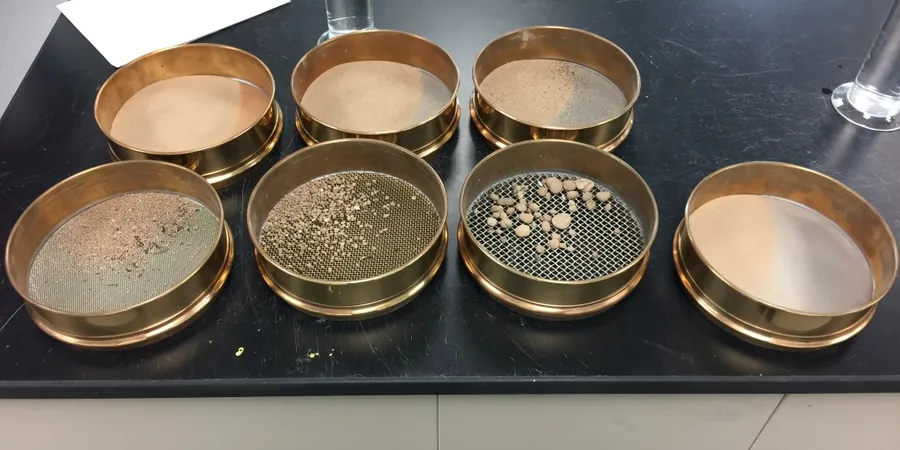
ASTM D6913 and D7928 define the two-part workflow we run most weeks in our lab: mechanical sieving for the coarse fraction, then a hydrometer sedimentation test for fines passing the No. 200 sieve. McKinney sits on the Western edge of the Blackland Prairie, where weathered Eagle Ford Shale and Taylor Marl produce clay-rich residual soils that often hold 60–90% passing the No. 200. Contractors and geotechnical engineers across Collin County request the combined method because plasticity alone won't tell you whether a lean clay will drain or trap water. We see this daily on US-380 corridor projects and residential subdivisions east of Lake Forest Drive, where the soil profile can shift from stiff fissured clay to silty sand within 300 feet. For sites where deep moisture variation is suspected, we pair the grain size data with an atterberg limits run on the same bag sample to correlate the fines fraction with the plasticity chart per the Unified Soil Classification System.
When 80% of your sample passes the No. 200 sieve, the hydrometer isn't optional—it's the only way to separate silt that drains from clay that holds water for months.
Methodology and scope
The combined report includes percent gravel, sand, silt, and clay, the coefficient of uniformity Cu, coefficient of curvature Cc, and a particle-size distribution chart on a semi-log scale. These numbers feed directly into frost-heave susceptibility checks, internal erosion criteria for embankment dams, and filter design for retaining structures. On several recent commercial pads near McKinney National Airport, the grain size curves confirmed borderline silty sand material that required a filter fabric specification change mid-project.
Local considerations
The Blackland Prairie's shrink-swell rhythm—wet winters, baking summers—makes grain size data a frontline tool for risk assessment in McKinney. A soil with 70% clay fraction will move far more than a soil with 70% silt, even if both classify as fine-grained. When the particle-size curve shows a gap-graded or bimodal distribution, internal erosion becomes a real concern under sustained seepage, especially behind retaining walls along the US-75 frontage roads where drainage paths are short. We've also seen cases where hydrometer results revealed a 15–20% colloidal clay content below 0.001 mm in soils that the sieve analysis alone called silty sand. That colloidal fraction governs long-term secondary compression and can double the predicted settlement under fill loads. Skipping the hydrometer on a site with more than 25% passing the No. 200 is a gamble that shows up later as cracked slabs and misaligned door frames.
Applicable standards
ASTM D6913-22 – Standard Test Methods for Particle-Size Distribution of Soils Using Sieve Analysis, ASTM D7928-21 – Standard Test Method for Particle-Size Distribution of Fine-Grained Soils Using the Sedimentation (Hydrometer) Analysis, ASTM D2487-17 – Standard Practice for Classification of Soils for Engineering Purposes (Unified Soil Classification System), ASTM D422-63(07)e1 – Standard Test Method for Particle-Size Analysis of Soils (historical reference), AASHTO T 88-22 – Particle Size Analysis of Soils
Associated technical services
Combined Sieve + Hydrometer Package
A single report covering the full particle-size distribution from 3 inches down to the clay colloid range. We run ASTM D6913 on the +200 fraction and ASTM D7928 on the minus-200 material, then merge the two curves into one semi-log plot. This is the standard deliverable for foundation investigations, embankment borrow-source qualification, and stormwater infiltration screening anywhere in Collin County.
Wash-No.200 With Hydrometer Only
For samples where the coarse fraction is already known or irrelevant, we perform a sieve wash over the No. 200 to determine the fines percentage, then proceed directly to the hydrometer sedimentation test on the washed fines. This streamlined option suits pavement subgrade verification and trench backfill checks where the critical question is silt-versus-clay proportion.
Typical parameters
Frequently asked questions
How much does a combined grain size analysis (sieve + hydrometer) cost for a McKinney project?
The combined ASTM D6913 plus D7928 package typically runs between US$110 and US$200 per sample, depending on whether we're processing a single bag or a batch from the same boring. Turnaround is usually three to four business days. Expedited same-week reporting is available for an additional fee.
What sample mass do you need for the hydrometer test?
We need roughly 200 grams of the minus-No.10 fraction for the hydrometer analysis, but we always ask for a full one-gallon zip-lock bag of the bulk sample so we have enough material to run the sieve stack first and still retain a representative split for the sedimentation cylinder.
My soils report says 'silty clay' but the grain size curve shows 40% sand. Is that a contradiction?
Not necessarily. The USCS classification uses the percent passing the No. 200 sieve, not just the clay fraction. A soil with 40% sand and 60% fines can still classify as CL or CH if the Atterberg limits plot above the A-line. The grain size curve gives you the particle distribution, but you need the plasticity data to nail the final group symbol.