A common mistake in McKinney is treating the entire site like it sits on uniform black clay. The reality is far more variable. A pavement section designed without a verified laboratory CBR test on the actual subgrade often fails within two seasons—edge cracking and rutting appear where the expansive soils near Wilson Creek soften after spring rains. We run the soaked CBR per ASTM D1883 to give the civil engineer a real number, not a textbook assumption. This value feeds directly into the AASHTO 93 pavement thickness equation. On projects near the Trinity River tributaries, where silty lenses sit between clay layers, we often pair the CBR with a grain size analysis to confirm fines content before finalizing the structural section. Getting the CBR wrong means either overbuilding and wasting budget, or underbuilding and facing warranty claims.
Soaked CBR testing per ASTM D1883 is the only reliable method to quantify subgrade strength on McKinney's expansive clays—field estimates alone are not enough.
Methodology and scope
Local considerations
The Eagle Ford Shale and Austin Chalk formations underly much of McKinney, but the near-surface soils across the eastern expansion zones are dominated by the Ozan and Wolfe City series—both classified as high-plasticity clays with a liquid limit frequently exceeding 50. These soils swell when wet and shrink during the dry Texas summers, creating a pavement subgrade that cycles between stiff and soft. A CBR test run at optimum moisture without soaking will overpredict the support by 30 to 50 percent. That error translates directly into insufficient base course thickness. The soaked CBR procedure cuts through that optimism. On commercial pad sites near US 75, where cut-fill transitions are common, the lab CBR on the fill material often governs the pavement design, not the native subgrade. Missing that detail leads to differential heave across the parking lot within the first two years.
Applicable standards
ASTM D1883-21 – Standard Test Method for California Bearing Ratio (CBR) of Laboratory-Compacted Soils, ASTM D698-12 – Standard Test Methods for Laboratory Compaction Characteristics of Soil Using Standard Effort, ASTM D2487-17 – Standard Practice for Classification of Soils for Engineering Purposes (Unified Soil Classification System), AASHTO T 193 – Standard Method of Test for The California Bearing Ratio, TxDOT Tex-120-E – Soil Compaction Control
Associated technical services
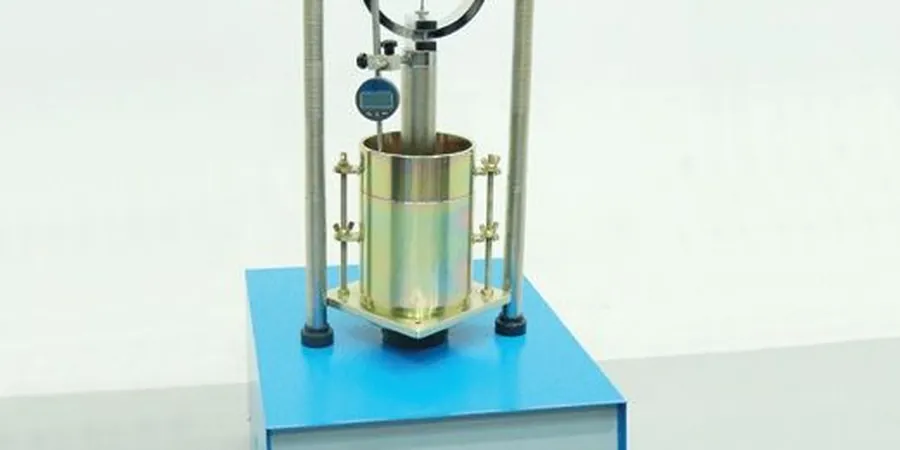
Standard Soaked CBR (ASTM D1883)
Three-point compaction with 96-hour soak. We report the corrected CBR at 0.1-inch and 0.2-inch penetration, plus the swell percentage. Suitable for flexible and rigid pavement subgrade evaluation per the AASHTO 93 design guide.
CBR on Treated Subgrade and Base Course
Testing of lime-stabilized or cement-treated soils commonly specified by TxDOT for McKinney's expansive clay zones. We mold specimens at the design stabilizer content and cure them before soaking, following the project-specific curing protocol.
Typical parameters
Frequently asked questions
What does a laboratory CBR test cost for a McKinney pavement project?
A standard three-point soaked CBR test per ASTM D1883 runs between US$110 and US$180 per specimen, depending on the number of points and whether we also run the companion Proctor compaction curve. Projects requiring multiple samples from different lift materials or treated subgrades are priced per specimen, with volume discounts available for larger testing programs.
How long does the soaked CBR test take from sample molding to final report?
The full procedure takes a minimum of five working days. We mold and compact the specimens on day one, then submerge them for the mandatory 96-hour soak. Penetration testing and data reduction happen on day five, with the signed report issued the same day. Rush scheduling is available if the lab bench is clear.
Do you test at field moisture or only after soaking?
For McKinney subgrades, we always recommend the soaked procedure. The seasonal moisture cycles here—winter rains followed by summer drought—mean the unsoaked CBR is not representative of long-term conditions. If the design engineer specifically requests an unsoaked value for a temporary haul road, we can run that variation, but the standard report will flag it as a non-standard condition for permanent pavement design.
Can the CBR test be run on lime-stabilized subgrade from a McKinney site?
Yes. We test chemically stabilized soils regularly for TxDOT and municipal projects. The curing period and moisture conditioning are adjusted to match the project specification—typically seven days of moist curing followed by a four-day soak. We report the treated CBR alongside the untreated baseline so the engineer can quantify the improvement from the stabilizer dosage.