The rolling terrain east of McKinney, where the Blackland Prairie transitions toward the Austin Chalk formation, creates slope conditions that surprise even experienced developers. Those gentle-looking inclines along Highway 380 and near the Trinity River tributaries hide expansive clay layers that shift dramatically with seasonal moisture changes. We run into this constantly at the lab. A slope that stood fine through two dry summers can start creeping after one wet winter. Our team tackles this by combining field instrumentation data with lab-measured residual shear strength parameters, giving you a stability number you can actually bank on. When conditions push beyond simple 2D limit equilibrium, we integrate deep excavation monitoring data to validate the model against real ground movements during construction.
A slope stability analysis without site-specific residual shear strength from the lab is just a guess dressed in software output.
Methodology and scope
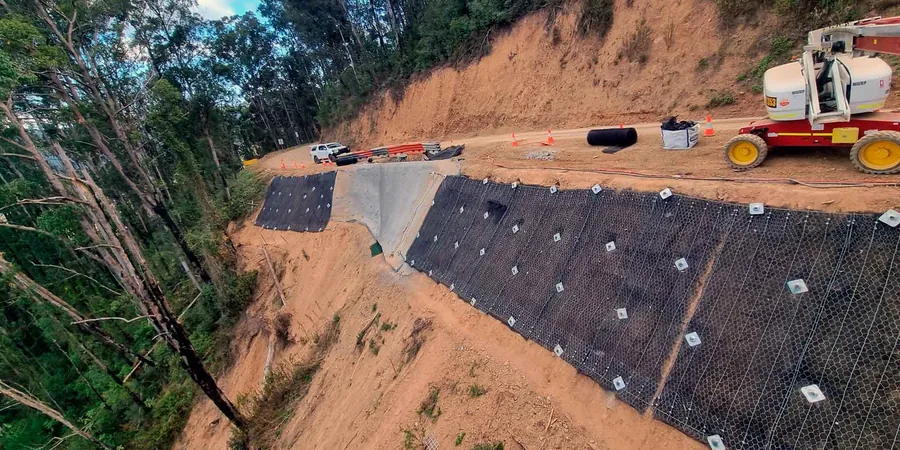
Local considerations
McKinney's growth from a small farming town of 4,700 in 1950 to over 210,000 today pushed residential and commercial development onto terrain that earlier generations left as pasture. Those old farm ponds and eroded draws got filled, re-compacted with varying degrees of care, and built on. The geotechnical legacy is a patchwork of marginally stable slopes, some with undocumented fill, others with natural clay seams that daylight on cut faces. We get called in after the first big storm exposes a scarp in someone's backyard. The fix is always more expensive than the upfront analysis would have been. Our lab takes a conservative approach: we assume the worst-case phreatic surface until piezometer data proves otherwise, and we test for strain-softening behavior in the triaxial cell. For slopes adjacent to creeks feeding into the East Fork of the Trinity, we also examine toe erosion scenarios that can undercut a stable configuration within a single flood season.
Applicable standards
ASTM D7608-18: Standard Test Method for Torsional Ring Shear Test to Determine Drained Fully Softened Shear Strength and Nonlinear Strength Envelope of Fine-Grained Soils, FHWA-NHI-05-123: Soil Slope and Embankment Design, ASCE 7-22: Minimum Design Loads for Buildings and Other Structures, Seismic Provisions, ASTM D4767-11: Standard Test Method for Consolidated Undrained Triaxial Compression Test for Cohesive Soils
Associated technical services
Finite Element Slope Modeling
We build 2D and 3D models using strength parameters measured directly on McKinney site soils, incorporating actual stratigraphy from test pits and borings.
Residual and Fully Softened Shear Testing
Ring shear and reversal direct shear per ASTM D7608 and D3080 to capture the strength drop in high-plasticity Dallas-area clays after movement.
Groundwater and Seepage Analysis
Installing vibrating wire piezometers and modeling steady-state and transient flow to determine the phreatic surface used in stability calculations.
Typical parameters
Frequently asked questions
What does a slope stability analysis cost for a typical McKinney residential lot?
For a single-family lot with a cut or fill slope up to about 15 feet high, the analysis typically runs between US$1,180 and US$3,960, depending on whether we need to install piezometers, run ring shear tests on the clay, and generate multiple cross sections.
Do McKinney soils require special testing for slope design?
Yes. The expansive clays of the Eagle Ford and Austin Chalk formations can lose significant strength after weathering and movement. Standard triaxial tests often overestimate the available shear resistance, so we routinely run ring shear or reversal direct shear tests to obtain fully softened and residual strength parameters—values that better represent the soil after a slip begins.
How long does a full slope stability study take from field work to report?
For a typical commercial or residential project, allow three to four weeks. Drilling and sampling take a few days, consolidation and shear testing run one to two weeks, and the numerical modeling plus report drafting fills the final week. Projects requiring long-term piezometer monitoring extend the timeline accordingly.