With the population of McKinney Texas surging past 210,000, development is pushing into areas where the local geology demands serious engineering. We are dealing almost exclusively with the expansive clays of the Blackland Prairie—soils that can swell up to 10% in volume between dry summer and wet winter conditions. A retaining wall here is not a standard structural element; it is a dynamic interface between a moving earth mass and a fixed asset. In our projects across Collin County, we routinely encounter the Eagle Ford Shale formation at shallow depths, which adds a layer of complexity due to its weathered, slickensided nature. Properly characterizing the ground with a test pit investigation is our first step to determine the depth of the active moisture zone, ensuring the wall design accounts for the full seasonal heave cycle.
In McKinney's expansive clays, the most critical retaining wall component is the drainage system, not the concrete or steel.
Methodology and scope
Local considerations
The risk profile for a retaining wall in the historic downtown McKinney area versus a newer subdivision like Trinity Falls is markedly different. Downtown, we often encounter undocumented fill over the original Austin Chalk, creating a perched water table that can saturate the backfill and double the lateral load on the wall. In contrast, the subdivisions built on former agricultural land have a deep, homogeneous profile of Houston Black Clay, where global slope stability becomes the primary concern if the wall is tiered. A common failure mode we see in the region is rotational sliding of gravity walls during prolonged wet spells, where the clay's undrained shear strength drops below 500 psf. Ignoring the slope stability analysis of the overall site, even for a short wall, is the fastest way to a costly structural failure.
Applicable standards
IBC 2021 (adopted by City of McKinney with local amendments), ASCE 7-22 Minimum Design Loads and Associated Criteria for Buildings and Other Structures, ASTM D1586-18 Standard Test Method for Standard Penetration Test (SPT) and Split-Barrel Sampling of Soils, ASTM D2487-17 Standard Practice for Classification of Soils for Engineering Purposes (Unified Soil Classification System), AASHTO LRFD Bridge Design Specifications (for MSE walls with traffic surcharge)
Associated technical services
Cantilever and Gravity Wall Engineering
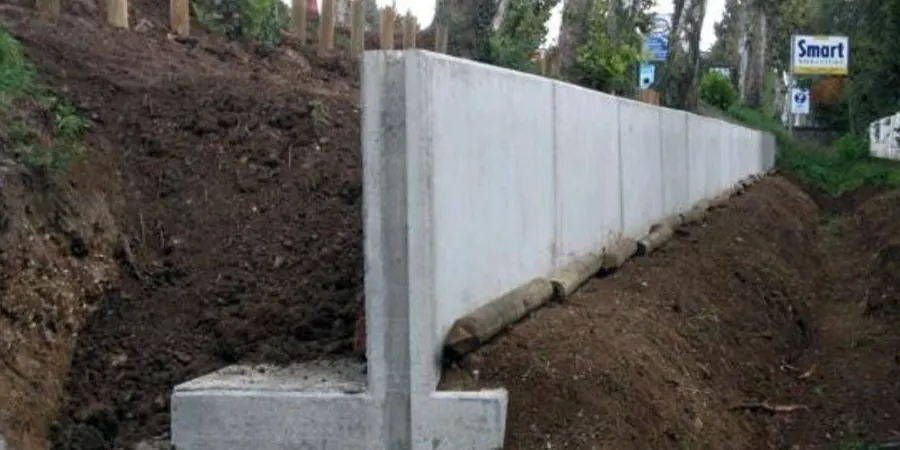
For walls up to 15 feet, we design reinforced concrete cantilever walls with integral drainage galleries to handle the high lateral pressures from saturated Blackland Prairie clay. Our calculations include a full global stability check using Spencer's method and a detailed settlement analysis to prevent differential movement at the wall face.
Mechanically Stabilized Earth (MSE) Wall Systems
For taller tiered applications common in McKinney's commercial developments, we specify MSE walls using geogrid reinforcement with select granular backfill. We focus on the long-term creep behavior of the reinforcement in the alkaline environment of the Eagle Ford Shale, ensuring a 75-year design life per FHWA guidelines.
Typical parameters
Frequently asked questions
What is the typical cost range for a retaining wall design in McKinney Texas?
For a standard residential retaining wall design with geotechnical investigation, the cost typically ranges from US$1,180 to US$4,550. The final figure depends on the wall height, the complexity of the soil profile, and whether a topographic survey is required. A taller wall or one adjacent to a property line will be at the higher end due to the additional analysis for surcharge and global stability.
How deep should the footing be for a retaining wall in McKinney's expansive clay?
The footing must extend below the zone of seasonal moisture fluctuation, which in McKinney we typically establish at a minimum depth of 30 to 36 inches. However, if the Eagle Ford Shale bedrock is encountered higher, we may embed the footing directly into the weathered shale to provide a bearing stratum that is not susceptible to swell.
What type of backfill material do you recommend behind retaining walls in this region?
We strictly specify a free-draining, open-graded aggregate like ASTM C33 #57 stone, placed in 12-inch lifts and compacted. A non-woven geotextile filter fabric must separate the aggregate from the native expansive clay to prevent fines migration that would clog the drainage system and build up hydrostatic pressure.
Does the city of McKinney require a permit and an engineer's stamp for retaining walls?
Yes, the City of McKinney requires a building permit for any retaining wall over 4 feet in height, measured from the bottom of the footing to the top of the wall. An engineered design with a Texas-licensed Professional Engineer's seal and a supporting geotechnical report is mandatory for these permits to be issued.