McKinney’s growth from a quiet agricultural town to one of the fastest-growing cities in the country has pushed development into areas where the soil profile changes dramatically over short distances. The Eagle Ford Shale and Austin Chalk formations underlie much of Collin County, but what builders actually contend with are the weathered clays and silty sands at the surface — materials whose strength and compressibility can vary within a single lot. We run the Cone Penetration Test in McKinney because it delivers a continuous, high-resolution log of tip resistance, sleeve friction, and pore pressure without the disturbance that sampling introduces. For projects where time on site matters — a commercial pad near US 75, a residential subdivision expanding east toward Princeton — the CPT provides actionable stratigraphy in a fraction of the time required by conventional drilling. The data feeds directly into bearing capacity calculations, settlement analyses, and liquefaction screening, all while meeting the documentation requirements of the IBC and local building officials.
Continuous CPT data captures the clay-to-chalk transition that standard split-spoon samples miss entirely.
Methodology and scope
Local considerations
The climate in McKinney swings from prolonged summer drought to intense spring rainfall events that saturate the upper clay layers in a matter of hours. This seasonal moisture cycling creates a risk profile that static borings alone cannot fully characterize. A CPT sounding run in August may encounter stiff, desiccated clay with qc values exceeding 4 MPa, while the same location tested in April could show soft, wet clay with qc below 1 MPa in the upper 8 feet. We account for this by running dissipation tests and correlating with triaxial undrained shear strength when the project budget allows. Shrink-swell potential — a genuine concern for slab-on-grade foundations across Collin County — is inferred from the combination of low sleeve friction and moderate tip resistance that indicates high-plasticity clays. Where the CPT detects a sudden drop in tip resistance below a stiff crust, the risk of differential settlement on shallow footings rises significantly, and we flag those zones in the report for the structural engineer to address with either deepened bearing or ground improvement.
Applicable standards
ASTM D5778-20, IBC 2021 Chapter 18, Robertson (2016) SBT classification, TxDOT Tex-132-E for CPT in transportation projects
Associated technical services
Standard CPT Soundings for Foundation Design
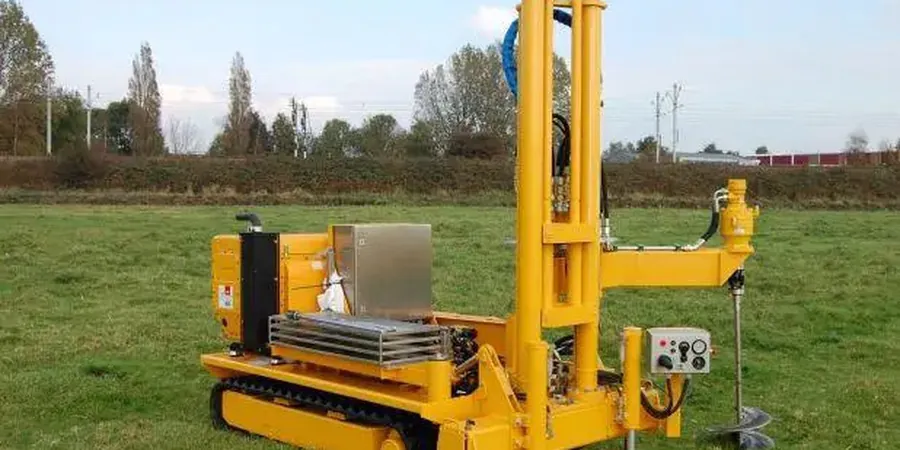
We mobilize a 20-ton reaction truck and push electric cones to refusal or project depth, delivering logs with qc, fs, Rf, and u2. The report includes soil behavior type classification, equivalent SPT N60 values for engineers accustomed to traditional correlations, and direct bearing capacity estimates for shallow footings on the weathered Eagle Ford formation common across McKinney.
CPTu with Pore Pressure Dissipation Testing
For projects where settlement rate is a concern — particularly near the floodplain of the East Fork Trinity River or on sites with known alluvial deposits — we add piezocone capabilities. Dissipation tests at multiple depths provide the coefficient of consolidation, which feeds directly into time-rate settlement calculations and helps the design team decide whether surcharging or vertical drains are warranted before construction.
Typical parameters
Frequently asked questions
How much does a CPT sounding cost in McKinney?
For sites within McKinney and the Collin County area, a single CPT sounding typically runs between US$150 and US$270 per hour of rig time, with a minimum mobilization charge applied. Total cost depends on the number of soundings requested, the depth of refusal or the specified target depth, and whether pore pressure dissipation testing is included. We provide a lump-sum quote after reviewing the site location and the scope of the geotechnical investigation.
What depth can CPT reach in the local Eagle Ford Shale?
In the weathered shale and residual clay terrain around McKinney, refusal typically occurs between 40 and 80 feet, though we have reached 130 feet in more deeply weathered zones. Refusal is defined by the cone encountering a layer where tip resistance exceeds the thrust capacity of the rig or where the rod friction becomes too high to maintain the required push rate without buckling.
Does CPT replace SPT borings for IBC compliance?
Under IBC 2021, CPT data can be used to determine soil classification, bearing capacity, and seismic site class provided the correlation methods are properly documented and signed by a licensed geotechnical engineer. Many McKinney projects combine CPT soundings with a limited number of SPT borings to satisfy local building official preferences while still benefiting from the continuous profile that CPT offers.
How do you interpret CPT data for expansive clay classification?
Expansive clays show a characteristic signature in CPT logs: low tip resistance combined with very low sleeve friction values that produce a friction ratio above 4 percent. We correlate this with the soil behavior type index and, when paired with laboratory testing on thin-wall samples, can estimate the plasticity index and potential swell pressure. This interpretation is specifically calibrated for the Cretaceous-age clays encountered across McKinney.
How many CPT soundings does a typical McKinney commercial site need?
The number depends on the building footprint and the variability of the subsurface conditions. For a commercial pad of 20,000 to 50,000 square feet, we generally recommend a minimum of three to five soundings arranged on a grid pattern, with additional soundings at the corners of the proposed building envelope. Sites near the transition zones between the Austin Chalk and Eagle Ford formations may require tighter spacing to capture lateral changes in the weathered profile.