Seismic engineering in McKinney, Texas, addresses site-specific hazards tied to the region’s expansive clays, alluvial terrace deposits, and proximity to the Balcones Fault Zone. While North Texas experiences low-to-moderate seismicity, compliance with the International Building Code and local amendments requires thorough ground-motion characterization. Our work often begins with seismic microzonation to map variable shaking potential across a site, then integrates soil liquefaction analysis where saturated, loose granular lenses are encountered beneath the stiff near-surface soils common in Collin County.
These studies are mandatory for essential facilities, high-occupancy structures, and deep excavations where performance-based design governs. For critical infrastructure, we couple dynamic site response with base isolation seismic design to reduce demand on superstructures. Whether supporting a hospital expansion or a mixed-use mid-rise, our deliverables align directly with ASCE 7 Chapter 20 site classification procedures, providing geotechnical parameters that structural engineers can apply without re-interpretation.
Anchor bond stress in McKinney's high-plasticity clays can fluctuate by 30% between dry summer conditions and the winter wet season, making seasonal site characterization essential.
Methodology and scope
Local considerations
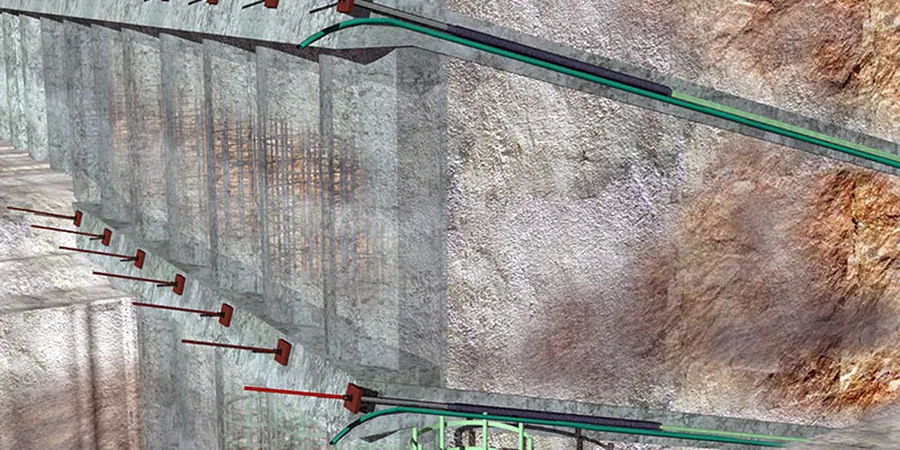
A six-story mixed-use development on McKinney's historic downtown square required a 28-foot excavation directly adjacent to a 1920s unreinforced masonry building. The initial geotechnical report suggested a soldier pile and lagging wall with three rows of active tiebacks, but the first performance test revealed creep rates exceeding the 2 mm per decade-minute threshold at 85% of the lock-off load. The bond zone had been designed assuming a uniform clay with an undrained shear strength of 1,200 psf; what the driller encountered was a slickensided layer at 14 feet that reduced the bond stress capacity by more than half. We redesigned the lowest anchor row as a deeper, longer tendon socketed into the underlying shale, and the wall deflections stabilized within the 0.5-inch limit required to protect the adjacent historic facade. The lesson is clear: anchor design in McKinney's heterogeneous geology must be validated by on-site load testing, not just theoretical models, because a single weak interface can compromise an entire retention system and expose the developer to costly third-party damage claims.
Applicable standards
ASTM A944-22: Standard Test Method for Comparing Bond Strength of Steel Reinforcing Bars to Concrete Using Beam-End Specimens, FHWA GEC No. 4: Ground Anchors and Anchored Systems (Sabatini, Pass, Bachus), PTI DC35.1-14: Recommendations for Prestressed Rock and Soil Anchors, IBC 2018 Section 1810: Deep Foundations (anchor bond stress criteria), ASCE 7-16 Section 12.13: Seismic Design Requirements for Earth Retaining Structures
Associated technical services
Active Anchor Design & Load Testing
Complete design of prestressed strand or bar anchors for tied-back walls and deep excavations. Includes bond stress calculations based on site-specific soil parameters, free-length determination extending beyond the critical failure surface, corrosion protection specification per soil aggressiveness classification, and a stamped load test procedure. We perform on-site performance and proof testing, analyze creep data, and provide lock-off recommendations. Submittal package includes anchor schedule, grout mix design, sacrificial anode details when required, and a construction sequence narrative coordinated with the excavation support system.
Passive Anchor & Soil Nail Systems
Design of passive bar anchors and soil nails for slope stabilization, basement wall underpinning, and retaining wall reinforcement in McKinney's expansive clay terrain. We determine nail spacing, inclination, and bond length using FHWA GEC No. 7 and AASHTO LRFD methodologies. The design accounts for the long-term reduction in bond stress due to wet-dry cycling in the active zone, typically the upper 8 to 12 feet in Collin County. Deliverables include a nail layout plan, facing connection details, shotcrete or reinforced concrete facing design, and a construction quality control plan that specifies pullout testing frequency per IBC 2018.
Typical parameters
Frequently asked questions
What is the difference between active and passive anchors, and which one suits a McKinney site with high-plasticity clay?
Active anchors are prestressed tendons that apply a compressive load to the retained soil mass before any excavation-induced movement occurs; they are tensioned to a lock-off load and actively restrain the wall. Passive anchors (often called soil nails or dowels) only develop resistance once the soil mass begins to deform and transfer load into the anchor. In McKinney's expansive clays, active anchors are generally preferred for cuts deeper than 15 feet or when adjacent structures cannot tolerate lateral movement. The prestress force counteracts the swelling pressure that develops during wet seasons, maintaining positive contact between the wall and the soil. Passive systems work well for shallow slope reinforcement where some deformation is acceptable, but the bond stress assumptions must be reduced by 25–30% to account for the slickensided surfaces common in the Taylor Marl formation.
How much does an anchor design and load testing package cost for a McKinney commercial excavation?
The design and testing scope for a typical McKinney commercial project ranges from US$1,080 to US$4,300, depending on the number of anchor rows, the complexity of the corrosion protection system, and the required number of performance and proof tests. A simple passive soil nail design for a shallow slope may fall at the lower end, while a multi-row active tieback system with double-encapsulation corrosion protection and a full ASTM A944 load test program for 20+ anchors will approach the upper range. Each proposal is project-specific and includes stamped calculations, the load test procedure, and the construction-phase testing report.
What corrosion protection level does the IBC require for permanent anchors in McKinney soils?
The 2018 International Building Code references PTI DC35.1 for corrosion protection classification. For McKinney's residual clays, which often have sulfate concentrations exceeding 200 ppm and pH values between 5.5 and 7.0, a Class I (double-encapsulation) protection system is typically mandated for permanent anchors. This includes a corrugated plastic sheathing over the tendon bond zone, a smooth sheathing over the free length, and a grout-filled encapsulation that isolates the steel from the surrounding soil. Temporary anchors with a service life under 24 months may use Class II protection (single encapsulation) if soil resistivity testing confirms low corrosion potential. Our submittal includes the resistivity and pH data that justify the selected protection class.
How is anchor bond stress verified during construction in McKinney?
Bond stress is verified through on-site load testing following ASTM A944 and the FHWA GEC No. 4 performance test protocol. For active anchors, we specify a performance test on at least 5% of production anchors, applying incremental loads up to 133% of the design load while measuring creep at each load step. The anchor passes if the creep rate stabilizes below 2 mm per log cycle of time. Proof tests at 133% of design load are conducted on all remaining anchors. In McKinney's variable clay profiles, we often recommend an additional sacrificial test anchor installed in the most critical soil zone — typically the slickensided interface between the weathered and intact shale — to validate the design bond stress before production drilling begins.