A five-story mixed-use building on McKinney's historic downtown square ran into a problem during preliminary geotechnical work: the upper 15 feet of soil was loose, undocumented fill from decades of redevelopment, sitting above dense Eagle Ford Shale. The structural loads were moderate, but differential settlement risk was severe. The solution required a densification strategy that wouldn't damage adjacent century-old brick facades. Vibrocompaction design in McKinney Texas demands exactly this kind of surgical precision—improving bearing capacity and standardizing settlement behavior without the vibration damage risk that traditional dynamic compaction brings. The design process integrates site-specific energy input curves, probe spacing, and real-time monitoring parameters. For sites with variable fill thickness, the design often coordinates with targeted test pits to physically verify the depth and composition of man-made deposits before finalizing the grid layout.
A well-calibrated vibrocompaction design turns loose urban fill into a uniform, dense foundation medium with settlement reduced by 60 to 80 percent.
Methodology and scope
Local considerations
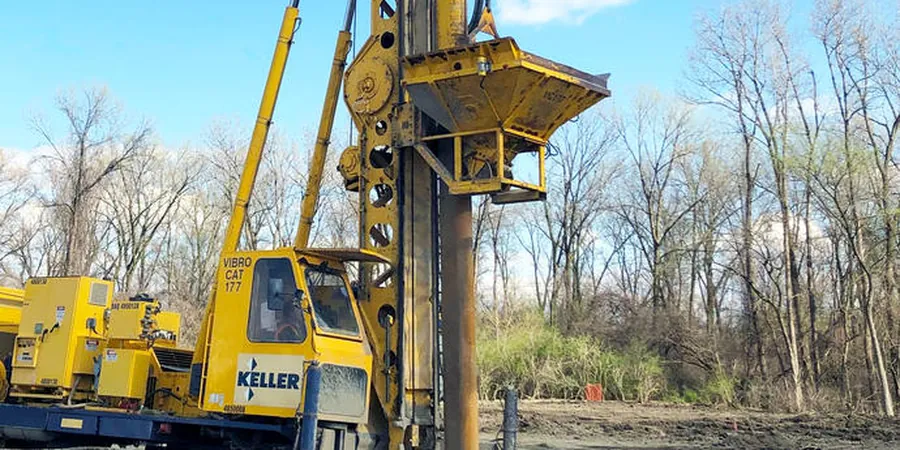
The vibroflot rig itself is a substantial piece of equipment—a crawler crane or purpose-built leader rig suspending a 12- to 18-inch diameter cylindrical probe that weighs several tons, with internal eccentric weights spinning at 1,800 rpm to generate horizontal vibratory force. In McKinney's tighter urban lots near the Cultural District or along US 75 service roads, site access dictates design choices. A smaller electric vibroflot might replace a larger hydraulic unit to fit between existing structures. The biggest risk in a poorly executed design is not just inadequate densification—it is creating a densified crust over loose material, which masks the real problem until the building is up and settlement cracks appear. Our design protocol specifies multiple test sections and pre-qualification of the vibroflot operator's control parameters before production work begins.
Applicable standards
ASTM D1586-18 Standard Test Method for Standard Penetration Test (SPT), ASCE 7-22 Minimum Design Loads and Associated Criteria for Buildings, IBC 2024 Section 1805 Ground Improvement, FHWA-NHI-16-072 Ground Improvement Methods Reference Manual, ASTM D5778-20 Standard Test Method for CPT
Associated technical services
Vibrocompaction Design Package
Includes soil characterization, target density specification, probe grid layout, energy input curves, and PPV monitoring protocol. Delivered as a sealed design report signed by the engineer of record.
Post-Treatment Verification Testing
CPT soundings at grid centroids and select SPT borings to confirm achieved relative density. Includes statistical analysis of improvement ratio and final bearing capacity letter for the structural engineer.
Typical parameters
Frequently asked questions
What soil conditions in McKinney make vibrocompaction a good option?
Sites with 10 to 40 feet of loose, clean sand fill over shale are ideal candidates. When fines content is under 15 percent and the water table is at least 5 feet below the treatment zone, the vibroflot can densify effectively. We confirm suitability with grain size analysis per ASTM D422 and SPT borings before committing to the design.
What does vibrocompaction design cost for a typical commercial lot in McKinney?
The design and verification package generally falls between US$1.540 and US$4.700, depending on the treatment area, number of test sections required, and the extent of post-treatment CPT verification. The design fee is separate from the specialty contractor's mobilization and production costs.
How do you protect adjacent buildings from vibration damage during compaction?
The design includes a vibration monitoring plan with seismographs placed on nearby structures. We set peak particle velocity (PPV) limits based on USBM RI 8507 criteria—typically 0.5 in/sec for historic masonry and 1.0 in/sec for modern concrete. Probe spacing and energy input are adjusted if readings approach the threshold.
Can vibrocompaction eliminate the need for deep foundations in McKinney?
In many cases, yes. When the design achieves a relative density above 70 percent in the treated zone, we can often recommend conventional spread footings at a higher bearing pressure instead of drilled piers to shale. This saves foundation cost and schedule. Each site requires a post-treatment bearing capacity analysis to confirm.