Contractors in McKinney lose time and money when fill compaction fails density testing. The culprit is usually a wrong moisture-density benchmark. We run the Proctor test right here in our accredited lab to define the maximum dry density and optimum moisture content for your site soil. Without it, nuclear gauge readings are just numbers on a screen. Collin County has fat clays in the Blackland Prairie and sandy loam pockets near the Trinity River tributaries. Each behaves differently under a compactor. Whether the spec calls for ASTM D698 Standard Proctor or ASTM D1557 Modified Proctor, we match the compactive effort to the job requirement. For pavement subgrades along US-75 or new residential pads in Stonebridge Ranch, getting the lab curve right avoids costly rework and failed inspection rounds. We complement this with sand cone density to correlate field compaction against the lab benchmark, and grain size analysis when material classification is needed.
A Proctor curve is not a formality. It is the difference between passing a nuclear gauge test on the first lift and ripping out compacted fill.
Methodology and scope
Local considerations
McKinney sits on the Eagle Ford and Woodbine groups, with highly plastic clays that shrink and swell with moisture change. When a Proctor test uses a sample that has dried out completely and been pulverized, the lab curve can shift relative to field behavior. We always check the natural moisture against the optimum before running the test. A common failure mode on local sites happens when fill is compacted wet of optimum in hot weather: the clay packs soft and develops deep roller ruts, failing the next day's density check. We also see imported fill from the Austin Chalk formation brought into subdivisions north of 380. It has a totally different compaction curve than native Blackland soil. Running the wrong Proctor curve on borrowed material leads to false passing results and long-term settlement under slabs. The IBC Chapter 18 and the local McKinney building code reference the Proctor as the baseline for engineered fill acceptance.
Applicable standards
ASTM D698-12, ASTM D1557-12e1, AASHTO T-99 (2022), AASHTO T-180 (2022)
Associated technical services
Standard Proctor (AASHTO T-99)
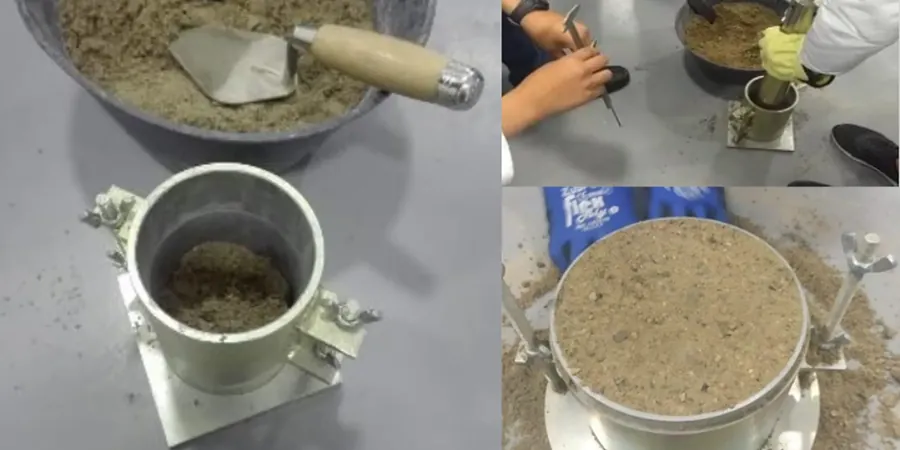
For low to medium compaction energy applications like landscape berms, shallow utility trenches, and residential foundation backfill. We process the sample through a No. 4 sieve and compact in a 4-inch mold with a 5.5-lb hammer dropped 12 inches.
Modified Proctor (AASHTO T-180)
For high-energy compaction on structural fill, building pads, and pavement subgrade under TXDOT specs. We compact in a 6-inch mold using a 10-lb hammer with an 18-inch drop, delivering 56,000 ft-lbf/ft³ of compactive effort.
Typical parameters
Frequently asked questions
How much does a Proctor test cost in McKinney?
A Standard or Modified Proctor test runs between US$100 and US$210 per sample, depending on the method and whether oversize correction is required. Volume pricing applies for multiple samples from the same site.
How long does the lab take for a Proctor curve?
Standard turnaround is 24 to 48 hours after we receive the sample. We can run same-day rush on a one-point or full curve if the sample arrives by early morning. Moisture content verification by oven drying adds a few hours but is mandatory for a valid curve.
What soil type needs a Modified Proctor instead of Standard?
Crushed limestone base, stabilized subgrade, and high-plasticity clays under structural fill typically need Modified Proctor. In McKinney, any fill under a building pad or a TXDOT pavement cross-section usually calls for T-180. Standard Proctor is sufficient for landscape fill and shallow utility trenches in low-load areas.
Can you run a Proctor on a sample we bring to the lab?
Yes, we accept field samples in sealed bags. We need about 40 lb of material for a Standard Proctor and 80 lb for a Modified with oversize correction. The sample must retain its natural moisture. We can also split the sample and run an Atterberg limits test on the same material if plasticity characterization is required.