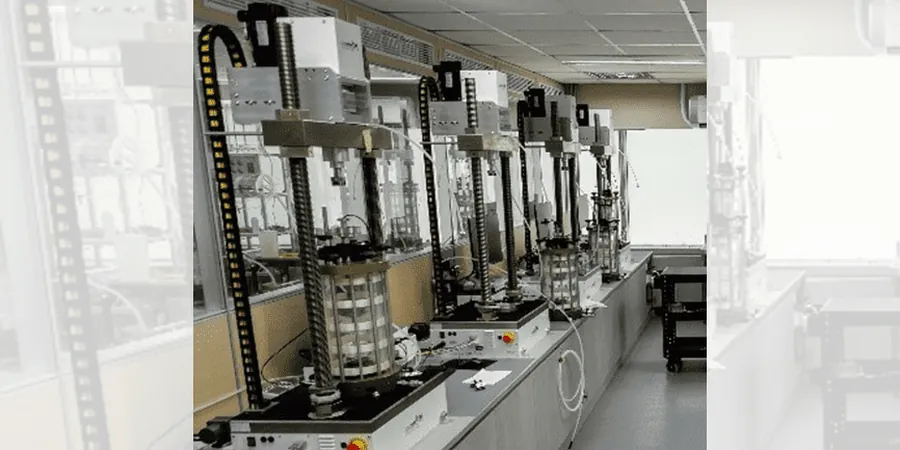
When the triaxial cell is pressurized in our laboratory, the first thing we check is the back-pressure saturation on the Houston Black clay samples that come in from sites around McKinney. The cell itself is a clear cylinder bolted to a steel base with two ports for confining fluid and a top-loading piston aligned to within a thousandth of an inch. For a city sitting at roughly 33.2°N latitude, where summer ground temperatures can shift pore pressures in low-plasticity silts, we run a multi-stage consolidated-undrained protocol with pore water measurement on every set. That means the sample inside the membrane is first saturated under a back pressure of at least 40 psi, then consolidated to the estimated in-situ stress, and finally sheared at a rate slow enough to let excess pore pressure equalize across a 2.8-inch diameter specimen. In McKinney, where subdivisions push into the Blackland Prairie, combining a triaxial program with a CPT test helps us pick the right consolidation stress before we ever trim a specimen.
Effective cohesion in a fissured McKinney clay can drop by half between peak and residual strength, and the triaxial's pore pressure transducer is the only tool that captures that transition.
Methodology and scope
Local considerations
McKinney added over 20,000 residents between the 2020 census and the start of 2025, and that pace of development pushes earthwork contractors into marginal soils that were skipped a generation ago. The Blackland Prairie clays that cover much of Collin County are high-plasticity, expansive, and riddled with slickensides, which means the peak friction angle from a single-stage triaxial test can overpredict stability if the design does not account for progressive failure along preexisting shear planes. On the alluvial corridors near Wilson Creek, loose silty sands at 8 to 15 feet depth show contractive behavior in undrained shear, and the triaxial pore pressure response tells us whether a deposit is susceptible to flow liquefaction under a rapid drawdown or a seismic event. For any McKinney project with a basement excavation deeper than 12 feet, skipping the triaxial stage leaves the shoring designer blind to the effective-stress envelope, and the resulting wall section may be too light for the lateral squeeze that a saturated clay can impose over a wet winter.
Applicable standards
ASTM D4767-11 (2020) – Consolidated Undrained Triaxial Compression Test for Cohesive Soils, ASTM D2850-15 – Unconsolidated-Undrained Triaxial Compression Test on Cohesive Soils, ASTM D7181-20 – Consolidated Drained Triaxial Compression Test for Soils, ASTM D4220/D4220M-14 – Practices for Preserving and Transporting Soil Samples
Associated technical services
CU with pore pressure (ASTM D4767)
Three-stage isotropic consolidation followed by undrained shear at a controlled strain rate, with continuous pore water pressure recording for effective-stress Mohr-Coulomb envelopes.
CD triaxial (ASTM D7181)
Drained shear on sands and low-plasticity silts, with volume-change measurement via back-pressure burette; suited for long-term slope stability and retaining wall analysis.
UU quick triaxial (ASTM D2850)
Unconsolidated-undrained testing for total-stress parameters, used as a screening tool on fissured clay samples or when tube disturbance is suspected.
Stress path and modulus reporting
We deliver p-q diagrams, secant modulus at 50 percent peak deviator stress, and Skempton's pore pressure coefficient Af for input into PLAXIS or FLAC models.
Typical parameters
Frequently asked questions
How much does a triaxial test cost for a McKinney project?
A standard three-stage consolidated-undrained triaxial program with pore pressure measurement typically runs between US$2,040 and US$2,620 per specimen, depending on whether we run one effective consolidation stress or a full Mohr-Coulomb envelope with three confining pressures. The price includes back-pressure saturation, B-value verification, shear at the ASTM-specified rate, and the final report with stress-strain curves and interpreted c-phi values.
How long does a triaxial test take from sample arrival to the report?
For a consolidated-undrained test on a McKinney clay, saturation alone can take 24 to 48 hours to reach a B-value above 0.95, and consolidation under the first confining stress adds another 24 hours. The shear stage runs roughly 6 to 8 hours per confining stress, so a three-stage program is usually completed within 7 to 10 working days. Drained tests on sands take longer because the shear rate must be slow enough to prevent excess pore pressure buildup.
Do you need undisturbed samples from McKinney, or can remolded specimens work?
For effective-stress parameters we need undisturbed Shelby tube samples or block samples trimmed in the lab with minimal disturbance. Remolded specimens can be used for index-type UU tests, but the results only give total-stress undrained shear strength and will not capture the fabric or fissuring that controls the in-situ behavior of the Blackland Prairie clays around McKinney.
Which triaxial type should I specify for a retaining wall design in McKinney?
For a retaining wall on the expansive clays common in Collin County, we recommend a consolidated-undrained test with pore pressure measurement per ASTM D4767. The effective cohesion and friction angle from that test feed directly into long-term drained stability calculations, and the pore pressure response at failure helps the designer decide whether to use peak or fully softened strength for the backfill interface.