We worked on a commercial building off US-75 near Eldorado Parkway where the geotech report kept flagging expansive clay seams just four feet down. The structural engineer needed a bearing capacity over 2,500 psf. The site had dark, stiff clay with sand lenses. We ran a series of SPT borings to depth and tested undisturbed samples for swell potential. That project showed us something we see across McKinney: the upper stratum in this part of Collin County changes fast over short distances. A shallow foundation design can work well if you know where the active zone ends and how the clay reacts to moisture. For sites with high plasticity, we often recommend pairing the investigation with an Atterberg limits evaluation to pin down the shrink-swell risk before finalizing the footing geometry.
Presumptive bearing values from IBC Table 1806.2 mislead more often than they help in McKinney’s expansive clay terrain.
Methodology and scope
Local considerations
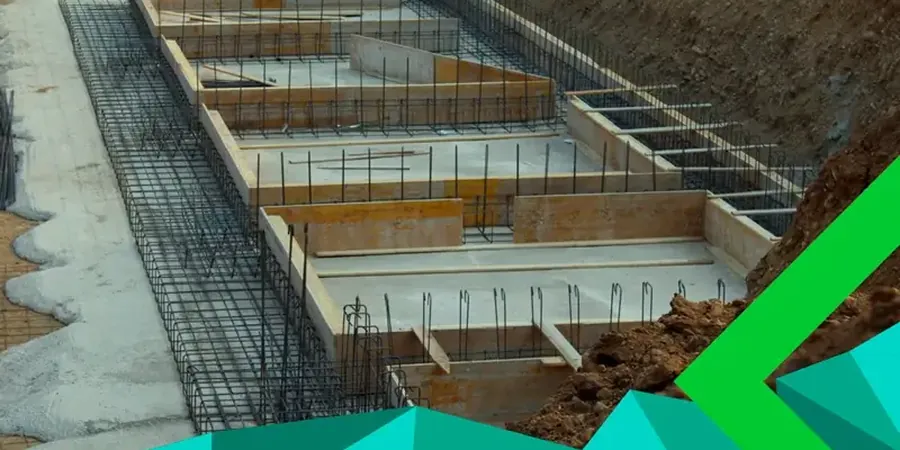
The Eagle Ford Group underlies much of McKinney. That formation weathers into a tan to gray, moderately expansive clay with a liquid limit that can exceed 50. When the clay dries out during a Texas summer, it shrinks. When it rains, it swells. A shallow foundation design without a moisture-control plan will move. We’ve measured vertical displacement over an inch in one season on light structures. The other risk is differential movement at the edge of the active zone. If one corner of a mat foundation sits on stiff clay and the other on weathered shale, the settlement is never uniform. We recommend a minimum of one boring per 2,500 square feet for commercial work and a full swell test suite on every project with footings wider than three feet.
Applicable standards
ASTM D1586-18 (Standard Test Method for Standard Penetration Test), IBC 2024 Chapter 18 (Soils and Foundations), ASTM D2487-17 (Classification of Soils for Engineering Purposes), ASTM D4318-17 (Liquid Limit, Plastic Limit, and Plasticity Index), ACI 318-19 Chapter 19 (Concrete: Durability Requirements)
Associated technical services
SPT Drilling and Sampling
Truck-mounted CME rigs for Standard Penetration Tests to 30 feet. We log every blow count, classify the soil, and ship split-spoon liners to the lab the same day.
Expansive Clay Test Suite
Atterberg limits, swell-consolidation, and suction testing on undisturbed Shelby tube samples. We deliver a shrink-swell classification and a recommended moisture-conditioned bearing value.
Bearing Capacity and Settlement Report
We provide an IBC-compliant report with net allowable bearing pressure, immediate settlement estimates, and a recommended foundation type for the specific site conditions in McKinney.
Typical parameters
Frequently asked questions
What is the typical allowable bearing pressure for shallow foundations in McKinney?
Based on our SPT data and lab tests across McKinney sites, we usually see net allowable bearing pressures between 2,000 and 3,500 psf for stiff clay at a depth of 4 to 5 feet. Values drop where the plasticity index exceeds 30 or where fill is present. Every site needs its own boring data.
How much does a shallow foundation design investigation cost in McKinney?
A typical investigation with two borings to 20 feet, Atterberg limits, and a bearing capacity report runs between US$2,050 and US$3,140. The final number depends on access, depth, and how many lab tests the structural engineer requires.
How deep should footings be placed in McKinney’s expansive clay?
We recommend a minimum embedment of 4 to 5 feet for isolated footings and at least 3 feet for mat foundations. This gets you below the worst seasonal moisture fluctuation and into a more stable moisture regime.
Do you test for sulfate attack in McKinney soils?
Yes. We run water-soluble sulfate tests per ASTM C1580 on soil samples from foundation depth. In McKinney, we frequently measure sulfate concentrations that put the soil in ACI exposure class S1 or S2, which affects the cement type specified for the concrete.
What lab tests are mandatory before a shallow foundation design in this area?
At minimum, we run moisture content, Atterberg limits, unconfined compression on undisturbed samples, and a particle-size analysis. For expansive clay sites, we add a one-dimensional swell-consolidation test. Every test follows ASTM standards referenced in the IBC.